EDGAR Rate Limits
SEC EDGAR Rate Limits: 10 Requests/Second Rule
Programmatically accessing the SEC's EDGAR database is fundamental to modern financial analysis, but every data pipeline eventually collides with its most critical constraint: the rate limit. The SEC's policy is explicit: no more than 10 requests per second from a single IP address. This rule exists to ensure system stability and fair access for all users, from institutional quants to individual investors.
For data engineers and structured-finance analysts building high-frequency surveillance models or training LLMs on filing data, exceeding this limit results in a temporary IP block—a critical failure point in any production workflow. Understanding how to work within these constraints is the first step toward building reliable, verifiable data pipelines. Platforms like Dealcharts help visualize and cite this data, bridging the gap from raw filings to structured, actionable insights.
Why EDGAR Scraping Rate Limits Matter in Structured Finance
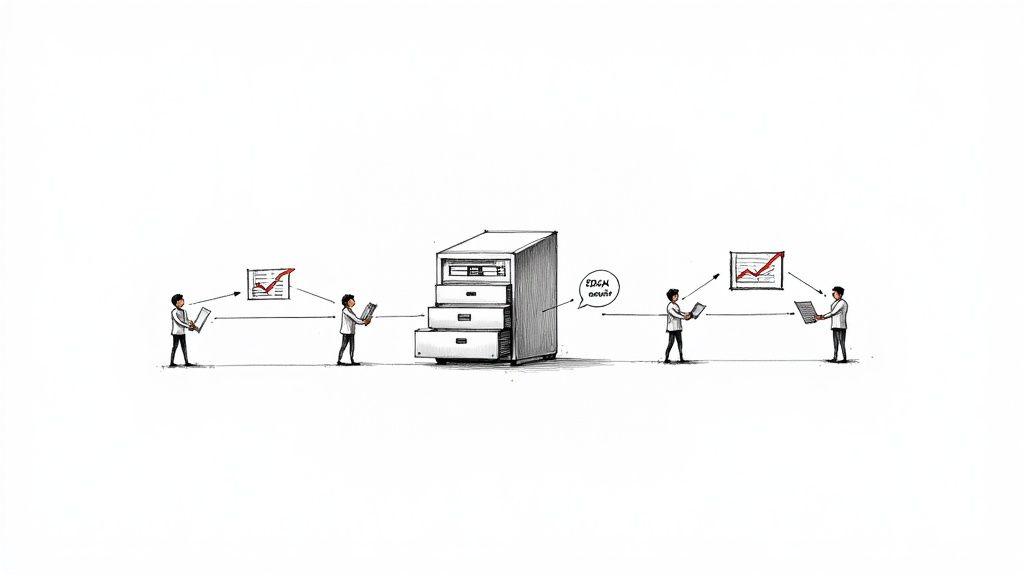
For quantitative analysts and data engineers, EDGAR is the source of truth for the U.S. capital markets. Filings like 10-Ks, 10-Ds for asset-backed securities (ABS), and 424B5 prospectuses contain the raw data that powers credit models, risk surveillance, and investment strategies. The challenge isn't just accessing this data; it's doing so at a scale that is both meaningful for analysis and compliant with SEC access policies.
This technical bottleneck creates significant challenges for professionals whose work depends on timely, complete data for critical workflows:
- ABS/CMBS Surveillance: Programmatically pulling monthly servicer reports (Form 10-D) to track collateral performance, delinquencies, and credit events across thousands of deals.
- Credit Modeling: Ingesting years of historical performance data from prospectuses (424B5) and remittance tapes to backtest and validate risk models.
- AI and LLM Training: Assembling massive, clean datasets to train models capable of extracting structured information from unstructured text in financial disclosures.
- Market Research: Aggregating data across issuers and asset classes to spot trends, such as shifts in underwriting standards in the 2024 CMBS vintage.
A poorly designed scraper that frequently triggers rate limits introduces gaps and unreliability into the data lineage, compromising the integrity of any subsequent analysis. Mastering compliant data ingestion is foundational to building financial analytics that are both verifiable and reproducible.
The Data Source: Decoding the SEC's 10 Requests Per Second Rule
The SEC's rate limiting policy is a hard, non-negotiable threshold applied across all EDGAR API endpoints. It caps automated requests at 10 per second for any single IP address. This policy was formally announced in response to the growing volume of programmatic access, which threatened to degrade performance for all users. You can find the original announcement on the SEC's website regarding new rate control limits for more background.
For developers, understanding what constitutes a "request" is crucial, as a single high-level task can trigger a cascade of individual HTTP calls.
What Counts as a Request?
A "request" is any distinct HTTP call made to an SEC server. Here's how quickly they accumulate, with each counting toward your 10-per-second quota:
- Fetching an Index File: A single request to get a daily, quarterly, or full master index.
- Accessing a Filing's Landing Page: A request to retrieve the HTML page listing all documents for a specific filing.
- Downloading an Individual Document: One request to pull the primary filing document (e.g., the 10-D).
- Downloading Exhibits: Each exhibit—whether a loan-level data tape, servicing agreement, or legal document—is a separate file and requires its own request.
A simple workflow to process a single 10-D with five exhibits can easily consume six requests. When processing thousands of filings, it's exceptionally easy to breach the limit without a disciplined, throttled approach.
The IP Address Scope
The SEC enforces this limit on a per-IP address basis. This means all traffic originating from a single public IP is aggregated. For teams operating behind a shared corporate network or a cloud VPC, this is a critical operational constraint. One analyst's aggressive script can get the entire organization's IP address temporarily blocked, halting all EDGAR-dependent workflows.
Building a compliant scraper requires more than
calls; it demands a coordinated approach to ensure total traffic from your network remains below the hard limit.time.sleep()
A Practical Workflow: Building a Compliant and Efficient EDGAR Scraper
Moving from theory to practice, building a robust EDGAR scraper involves defensive coding, smart design, and adherence to SEC policies. The goal is to create a reliable data pipeline that fetches filings without manual intervention or frequent failures.
First, you must identify your script. The SEC requires automated tools to declare a descriptive
string in the request header. This provides transparency and allows the SEC to contact you if your script causes issues.
Compliant
Example:User-AgentYourCompanyName ResearchBot (contact@yourcompany.com)
Failing to set a
makes your traffic indistinguishable from malicious bots, increasing the likelihood of being blocked.User-Agent
Second, even with a proper
, requests must be throttled. A simpleUser-Agent
between each request ensures you stay under the 10-requests-per-second limit.time.sleep(0.1)
This flowchart illustrates the failure sequence: unthrottled requests lead to errors and, ultimately, an IP block.
Finally, resilient scrapers must handle transient errors gracefully using exponential backoff. If a request fails, instead of retrying immediately, the script waits for a progressively longer period (e.g., 1 second, then 2, then 4) before the next attempt.
Here is a Python snippet demonstrating these principles: data lineage from URL to processed file.
import requestsimport time# Define a compliant User-AgentHEADERS = {'User-Agent': 'YourCompanyName ResearchBot (contact@yourcompany.com)'}def fetch_filing(url, retries=3, backoff_factor=0.3):"""Fetches a URL with exponential backoff and a compliant User-Agent."""# Source: The URL of the EDGAR filingfor i in range(retries):try:response = requests.get(url, headers=HEADERS, timeout=10)response.raise_for_status() # Raises HTTPError for bad responses (4xx or 5xx)# Transform: Successful retrieval of raw filing contentreturn response.contentexcept requests.exceptions.RequestException as e:print(f"Request failed: {e}. Retrying in {backoff_factor * (2 ** i)} seconds.")time.sleep(backoff_factor * (2 ** i))print(f"Failed to fetch {url} after {retries} retries.")return None# --- Example Workflow ---# A list of exhibit URLs from a 10-D filing to downloadfiling_urls = ["https://www.sec.gov/Archives/edgar/data/CIK/ACCESSION/primary-document.xml","https://www.sec.gov/Archives/edgar/data/CIK/ACCESSION/exhibit-1.xml","https://www.sec.gov/Archives/edgar/data/CIK/ACCESSION/exhibit-2.pdf"]for url in filing_urls:print(f"Fetching {url}...")filing_content = fetch_filing(url)if filing_content:# Insight: The content is now ready for parsing and analysis.print(f"Successfully fetched and processed {url}.")# CRITICAL: Always pause between distinct requests.time.sleep(0.11) # A buffer above the 0.1s minimum.
This script combines three best practices:
- Compliance (
): Identifies the scraper to the SEC.User-Agent - Resilience (Exponential Backoff): Handles network errors without overwhelming the server.
- Respect (Throttling): Stays safely within the 10 requests/second limit.
Implications for Modeling and Analysis
Mastering EDGAR's rate limits is not just a technical exercise; it's a prerequisite for building financial models and analytical workflows that are explainable and reproducible. For structured finance, where a single data point can originate from a specific sentence in a prospectus or a row in a remittance report, data lineage is non-negotiable.
This disciplined approach to data ingestion supports the shift toward "model-in-context" intelligence. Instead of relying on black-box data feeds, analysts can build systems where every output—whether a credit rating, a risk score, or an LLM-generated summary—can be programmatically traced back to its source document. This creates an auditable, verifiable chain of evidence that strengthens the credibility of any analysis. By embedding source trails directly into analytical workflows, teams create a system of record that is not just accurate but also defensible, ready for scrutiny by regulators, investors, or internal risk teams. This is the source-backed discipline CMD+RVL applies to structured-finance analysis.
How Dealcharts Helps
Scraping and maintaining EDGAR data pipelines at scale is a significant engineering challenge. For teams focused on analysis rather than data infrastructure, pre-built solutions offer a more efficient path.
Dealcharts connects these disparate datasets — filings, deals, shelves, tranches, and counterparties — so analysts can publish and share verified charts without rebuilding data pipelines. By providing structured, linked data derived from EDGAR, it allows teams to focus on generating insights rather than managing the complexities of rate limits and data parsing. Explore the structured finance context graph at https://dealcharts.org.
Conclusion
Navigating EDGAR scraping rate limits is a fundamental skill for any data-driven finance professional. By building compliant, resilient, and respectful data ingestion pipelines, you ensure the integrity of your source trail from document to insight. This commitment to verifiability is the foundation of reproducible, explainable financial analytics—a core principle of CMD+RVL's source-backed workflow discipline.
Article created using Outrank