
MBS Software Guide
Programmatic Guide to Mortgage Backed Securities Software
Anyone who has attempted to model mortgage-backed securities in a spreadsheet understands the operational risk. A meticulously built model buckles under the weight of a few hundred deals, its data lineage becomes untraceable, and its logic, brittle. This is a common rite of passage, but it is not a sustainable or auditable approach for risk management or alpha generation in structured finance.
This is the precise problem that dedicated mortgage backed securities software is designed to solve. It’s not merely an enhanced calculator; it is an integrated development environment for structured finance analysis. For analysts, data engineers, and quants, this software provides a reproducible sandbox to model cash flows, stress-test tranche behavior under various economic scenarios, and programmatically monitor deal performance. The data and insights generated can then be visualized and cited against public market data using platforms like Dealcharts.
The Role of MBS Software in Credit Markets

The value of a mortgage-backed security is not a single, static number. It is a probabilistic outcome derived from thousands of underlying loans, each governed by the complex waterfall logic codified in deal documents. The primary function of mortgage backed securities software is to ingest this disparate data, apply the rules of the capital structure, and project precisely how cash flows through the various tranches under user-defined assumptions.
The technical challenges are significant. Spreadsheets, while familiar, present serious limitations for institutional use:
- Scalability: Manually updating models for a large portfolio is not only inefficient but also a primary source of operational error. A single copy-paste mistake can invalidate an entire analysis.
- Auditability: Explaining the provenance of a single data point within a 50-tab spreadsheet to a compliance officer or investor is practically impossible. Modern finance demands verifiable data lineage.
- Logical Complexity: Attempting to code intricate waterfall rules, credit enhancement triggers, or prepayment models (e.g., PSA standard) in a grid of cells results in a system that is brittle and difficult to validate.
Purpose-built MBS software addresses these issues by providing a stable, auditable environment for managing monthly remittance data, monitoring deal performance, and ensuring every calculation has a clear, traceable path back to its source. As the global MBS market grows, projected to expand from $2,500 million in 2025 to $4,400 million by 2033, the demand for robust, programmatic tools to manage its inherent complexities will only increase.
This is where a connected data ecosystem becomes critical. An analyst can use their software for heavy-duty analytics and then cross-reference their model's output against market benchmarks on platforms like Dealcharts. For example, one could validate model assumptions by comparing them against the latest CMBS vintage data, blending proprietary analytical power with transparent market intelligence.
Data Sources and Programmatic Access
A superior mortgage backed securities software platform is defined by its data handling capabilities. The analytics engine is secondary to the system's ability to ingest, normalize, and programmatically link disparate data sources into a coherent, queryable structure. Without this foundation, even the most sophisticated cash flow models operate on unverified assumptions.
The structured finance ecosystem is a continuous stream of documents. Analysts and data engineers must navigate data from initial deal terms in 424B5 prospectuses, monthly performance data in EDGAR 10-D filings, and granular details buried in loan-level tapes. A top-tier platform must treat each source as a component of a single, unified narrative.
The Challenge of Data Fragmentation
The primary technical hurdle is data fragmentation. A deal’s CUSIP may reside in one system, its remittance reports in another, and its collateral details in a third. The substantive work—and where effective software demonstrates its value—is in programmatically linking these entities. This creates a unified view where an analyst can trace an insight from a high-level chart directly back to a specific clause in a source filing.
Modern workflows demand programmatic access. Today’s analysts and quants are not just point-and-click users; they are building automated surveillance scripts, custom risk models, and increasingly, AI-driven analytical tools. Consequently, any serious MBS platform must offer well-documented APIs that provide access to clean, structured data ready for integration into proprietary systems. As Large Language Models (LLMs) become more prevalent, the availability of LLM-ready datasets—data enriched with the context required for machine reasoning—is becoming a standard requirement.
The goal is to produce "attribution-ready data," a core principle of explainable finance and standards like the Open Data Providence Standard (ODPS). This means every data point, from delinquency rates to tranche balances, is accompanied by an auditable trail to its source. For an analyst examining a deal like the BMARK 2024-V7 transaction, this ensures the performance metrics are directly traceable to the latest servicer report, a critical component given that over 75% of MBS trades are still conducted OTC. Strong MBS analysis hinges on accurate and timely information. Knowing how to connect with different Lending Software solutions is key to building out solid MBS workflows.
Example: Programmatic Deal Surveillance Workflow
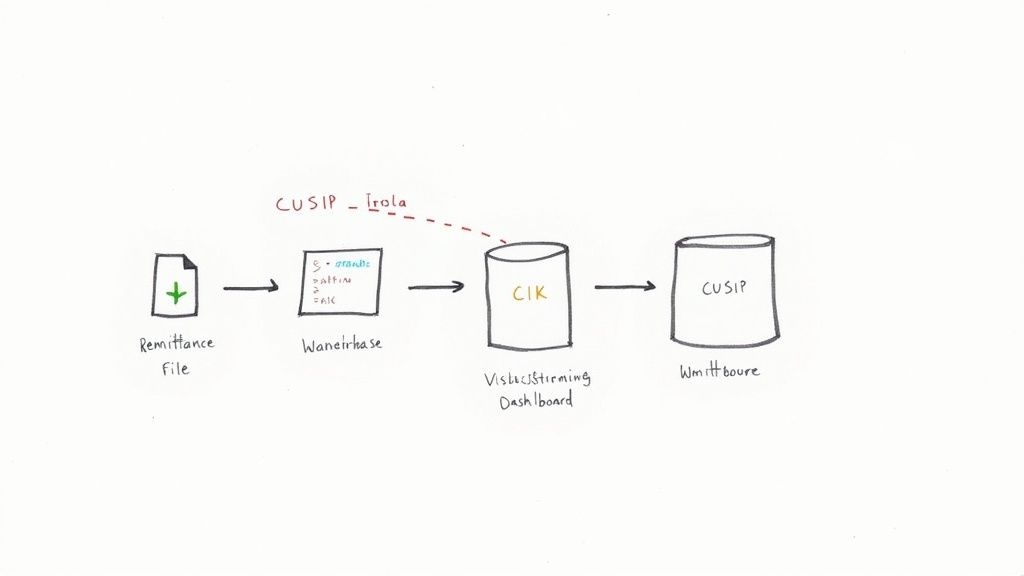
To illustrate the practical application, consider a common task for a CMBS analyst: monitoring the collateral performance for a specific deal. The objective is to retrieve the latest remittance report, extract key performance indicators (KPIs), and link this data back to the deal’s CUSIP and the issuer's CIK. This workflow demonstrates the data lineage chain: source → transform → insight.
A Python script using a platform's API would execute the following steps:
import requestsimport json# API credentials and endpointAPI_KEY = "YOUR_API_KEY"BASE_URL = "https://api.mbs-software.com/v1/"def get_latest_remittance(cusip):"""Fetches the latest 10-D filing for a given CUSIPand extracts key performance data."""headers = {"Authorization": f"Bearer {API_KEY}"}# 1. Source -> Find the deal and its latest filingdeal_response = requests.get(f"{BASE_URL}deals?cusip={cusip}", headers=headers)deal_data = deal_response.json()latest_filing_url = deal_data['filings']['latest_10d_url']# 2. Transform -> Get and parse the remittance dataremittance_response = requests.get(latest_filing_url, headers=headers)remittance_data = remittance_response.json() # Assuming structured JSON output# 3. Insight -> Extract and structure relevant metricsdelinquency_rate = remittance_data['collateral_summary']['delinquency_rate_60_plus']servicer_advances = remittance_data['servicer_advances']['total']insight = {"cusip": cusip,"cik": deal_data['issuer']['cik'],"filing_source": latest_filing_url,"delinquency_rate": delinquency_rate,"servicer_advances": servicer_advances}return insight# Example usage for a specific CMBS dealif __name__ == "__main__":target_cusip = "12345ABC6"performance_data = get_latest_remittance(target_cusip)# The output 'performance_data' contains both the insight and its provenanceprint(json.dumps(performance_data, indent=2))
This automated, repeatable process is completely transparent. The analyst can see precisely which filing the data originated from and the logic applied to derive the final metrics. There are no black boxes, creating an auditable and explainable data pipeline. This programmatic approach allows for scaling surveillance across a large portfolio, such as all deals related to the MSBAM 2025-C35 transaction, without manual intervention.
Implications for Modeling and Risk Monitoring
This shift from manual data wrangling to structured, programmatic analysis has profound implications. When every data point is enriched with its lineage and context, the quality of downstream applications—from risk models to AI reasoning engines—improves dramatically. This is the core principle of a "model-in-context" framework, where analytical models operate on data that is not just numerical but also semantically aware of its own origins and relationships.
For risk monitoring, this means surveillance alerts are no longer just triggered by a number crossing a threshold; they are accompanied by the source documentation that explains why the trigger was breached. For LLMs, it means they can answer complex queries like "Which servicers have the highest delinquency rates in post-2022 CMBS deals?" by reasoning over a graph of verified, interconnected data rather than performing simple keyword searches on unstructured text.
These explainable pipelines are the foundation of modern, defensible financial analytics. They transform analysis from an opaque, artisanal process into a reproducible, transparent discipline.
How Dealcharts Helps
The friction of sourcing, cleaning, and linking public structured finance data is a significant tax on analyst productivity. Dealcharts is designed to solve this specific problem. It connects the critical datasets—filings from EDGAR, deals, shelves, tranches, and counterparties—into a pre-linked, navigable knowledge graph. This allows analysts to publish and share verified charts without the prerequisite of rebuilding complex data pipelines from scratch. For data scientists and engineers, the same verified data is available programmatically, ready for integration into proprietary mortgage backed securities software and models.
Conclusion
The evolution of mortgage backed securities software is moving beyond monolithic cash flow engines toward integrated platforms that prioritize data lineage, programmatic access, and explainability. By establishing auditable data pipelines, these systems free analysts and quants from low-value data wrangling and empower them to build more sophisticated models, conduct scalable surveillance, and generate defensible insights. Frameworks like CMD+RVL's Context Engine provide the conceptual underpinning for this shift, enabling a future of reproducible and explainable financial analytics.
Ready to stop wrestling with data and start finding insights? Dealcharts connects public filings, deals, and counterparties into a single, navigable knowledge graph. It's built so you can focus on analysis, not data wrangling. Explore live deals and build your own charts.