
How to Purchase MBS
A Guide on How to Purchase Mortgage-Backed Securities
Investing in mortgage-backed securities (MBS) differs from purchasing standard equity or debt instruments. An investor acquires an interest in a pool of mortgage loans, not a single corporate entity. A successful approach requires a defined investment thesis, a systematic process for screening transactions, and rigorous due diligence.
The process begins with establishing a relationship with a broker-dealer to gain access to the primary and secondary markets. Market access is a prerequisite; the core of the investment process involves analyzing the underlying collateral and associated risks of a given security.
Understanding the MBS Market Structure
Before committing capital, a functional understanding of the market's architecture is necessary. MBS are structured financial products created from pools of residential or commercial mortgages. The principal and interest payments from these loans are passed through to investors. This pass-through structure creates a distinct risk and return profile.
The market is bifurcated into two primary segments. Differentiating between them is a fundamental first step in any analysis.
Agency vs. Non-Agency MBS
The initial filter in MBS analysis is determining whether a security is issued by a government-sponsored agency or a private entity. This distinction dictates the primary risks involved.
- Agency MBS: These securities are issued by Government-Sponsored Enterprises (GSEs) such as Fannie Mae and Freddie Mac, or guaranteed by Ginnie Mae, which carries the full faith and credit of the U.S. government. This guarantee effectively mitigates credit risk; investors receive payments even if borrowers default. The principal risk for Agency MBS is prepayment risk—the risk that borrowers will repay their loans ahead of schedule, typically during a period of falling interest rates, thereby reducing the investor's yield.
- Non-Agency MBS: Also known as private-label securities (PLS), these are issued by private institutions like investment banks. Lacking a government guarantee, investors are exposed to both credit risk and prepayment risk. This elevated risk profile is intended to be compensated by potentially higher yields.
Agency vs. Non-Agency MBS: Key Differences
This table outlines the core distinctions that drive investment decisions, from credit risk exposure to the typical investor base.
| Attribute | Agency MBS | Non-Agency (Private-Label) MBS |
|---|---|---|
| Credit Risk | Minimal; guaranteed by GSEs or the U.S. government. | Significant; investors are exposed to borrower defaults. |
| Issuers | Fannie Mae, Freddie Mac, Ginnie Mae. | Private entities like banks and investment firms. |
| Typical Investors | Risk-averse institutions, central banks, money managers. | Hedge funds, private equity, sophisticated investors. |
The choice between Agency and Non-Agency MBS is contingent on an investor's risk tolerance and macroeconomic outlook. Neither is inherently superior; they serve different strategic purposes within a portfolio.
The U.S. residential MBS market is dominated by Agency issuance, with the GSEs backing a market valued at approximately $9.2 trillion. The government guarantee makes Agency MBS a core holding for investors seeking stable income streams with minimal exposure to borrower default.
The core trade-off is clear: Agency MBS offer lower credit risk but are highly sensitive to interest rate fluctuations, while Non-Agency MBS introduce credit risk in exchange for potentially higher yields. The selection depends entirely on an investor's risk parameters and market view.
Primary Market Drivers
Beyond the Agency/Non-Agency classification, several factors influence market dynamics. The To-Be-Announced (TBA) market is a critical component for Agency MBS. It functions as a forward market, allowing participants to trade MBS for future settlement without specifying the underlying mortgage pools. This standardization enhances liquidity and establishes pricing benchmarks for the entire Agency MBS sector.
When analyzing a specific MBS, key metrics include yield and duration, which measure return and interest rate sensitivity, respectively. A unique and critical metric for MBS is prepayment speed, typically quantified as the Conditional Prepayment Rate (CPR).
CPR dictates the timing of cash flows and is difficult to predict, as it is influenced by interest rates, housing market activity, and borrower behavior. Analyzing commercial mortgage-backed securities (CMBS), for example, requires reviewing vintage data for commercial mortgage-backed securities to establish a baseline for performance based on the era of origination. This analysis is part quantitative, part qualitative.
How to Source and Screen Potential MBS Investments
Identifying suitable mortgage-backed securities requires a disciplined, systematic approach to filter a vast market of thousands of individual pools. A defined screening process is necessary to produce a manageable list of prospects that align with an investment strategy.
The process begins with an investment thesis. The objective—whether it is yield generation from high-coupon securities or prepayment protection from specific collateral features—determines the initial screening criteria.
Establishing Core Screening Parameters
The first step involves applying broad, quantitative filters. Professional investors use data platforms to narrow the universe of securities based on fundamental characteristics. This step is critical to avoid allocating time to analyzing bonds that do not fit the portfolio's mandate.
Common first-pass filters include:
- Issuer and Program: Delineating by issuer—Ginnie Mae (GNMA), Fannie Mae (FNMA), or Freddie Mac (FHLMC)—is a foundational step. Further specificity can be achieved by filtering by program, such as GNMA II pools, which have distinct servicing and payment structures.
- Coupon Rate: This isolates bonds within a target yield range. For instance, an investor might screen for pools with coupons between 4.5% and 5.5% to target a specific point on the yield curve.
- Weighted Average Loan Age (WALA): WALA indicates how seasoned the underlying mortgages are. A higher WALA may suggest more predictable prepayment behavior, while newly originated pools present greater uncertainty.
- Geographic Concentration: A screen can limit exposure to any single state or region, mitigating risks from localized economic downturns or climate-related events.
Establishing these initial parameters produces a relevant, though still large, subset of the market. The next phase involves more granular analysis of data signals that indicate potential performance. When analyzing CMBS, review the JP Morgan CMBS shelf to understand how a major issuer structures deals across different property types and markets.
Using Data Signals to Refine a Shortlist
With a smaller universe of securities, the screening becomes more sophisticated. The objective is to identify data points, or "signals," that suggest how a pool might behave relative to its peers, thereby identifying securities with a potential performance edge.
Key signals for consideration include:
- Historically Low Prepayment Speeds: Searching for pools that have consistently exhibited lower-than-average Conditional Prepayment Rates (CPR) can indicate a more stable borrower base or loan characteristics that make refinancing less probable.
- Attractive Yield Spreads: Comparing a pool's yield to a benchmark, such as a U.S. Treasury security, reveals its relative value. A wider spread may indicate higher risk, but it could also represent a pricing inefficiency.
- Loan Balance Distribution: Analyzing the percentage of loans with high or low balances provides insight into prepayment incentives. Pools with a high concentration of low-balance loans tend to prepay more slowly, as the financial benefit of refinancing is less significant for the borrower.
An effective screening workflow is not about finding a single "perfect" security. It is about systematically eliminating unsuitable options to build a high-probability shortlist worthy of in-depth due diligence.
A Practical Screening Scenario
Consider a portfolio manager seeking to purchase Ginnie Mae MBS with a focus on stable cash flows.
The workflow might proceed as follows:
- Initial Filter: The manager first screens for all GNMA II pools with a 4.0% coupon. This reduces the universe from thousands of MBS to a few hundred.
- Seasoning Filter: Next, a WALA filter is applied for pools with a seasoning greater than 24 months. This removes newly issued pools that lack a performance history.
- Signal Application: Finally, within this refined list, the manager searches for pools with a 3-month average CPR below 5%. This isolates a small, targeted group of securities that have demonstrated the low-prepayment characteristics sought.
This process transforms an overwhelming market into a manageable list of approximately a dozen bonds, each having passed a logical set of criteria and now ready for detailed pre-trade analysis.
Pre-Trade Due diligence on MBS
Once a shortlist of securities has been identified, the pre-trade due diligence process begins. This involves a meticulous examination of the underlying collateral and cash flow structure. This step is what distinguishes a calculated investment from speculation and must be completed before capital is deployed.
The goal is to move beyond the high-level statistics used for screening to analyze the loan-level data and build a robust performance model.
Collateral Analysis
The value and risk of an MBS are derived directly from the quality of its underlying mortgages. A granular analysis of the individual loans and borrowers is required to understand the security's fundamental characteristics.
Key data points to scrutinize include:
- Loan-to-Value (LTV) Ratios: This metric indicates the borrower's equity in the property. Pools with a high concentration of low-LTV loans (e.g., below 80%) are generally considered less risky, as borrowers have a greater financial incentive to avoid default.
- Borrower Credit Scores: FICO scores provide an indication of a borrower's creditworthiness. A pool with a weighted average FICO score above 740 suggests a financially sound group of borrowers.
- Property Types and Occupancy: The composition of the underlying properties is critical. A high concentration of investor-owned properties presents different risks compared to a pool of owner-occupied, primary residences.
- Geographic Diversification: A quantitative assessment of geographic risk is necessary. The distribution of properties across different states and metropolitan areas must be analyzed to mitigate exposure to regional economic downturns or natural disasters.
This level of detailed analysis provides a clear picture of the pool's credit quality. For example, examining the CSAIL 2021-C20 transaction reveals loan-level LTV ratios, FICO scores, and geographic distribution—critical inputs for MBS analysis.
Cash Flow and Prepayment Speed Modeling
After assessing collateral quality, the next step is to forecast cash flows. The primary challenge in valuing an MBS is projecting prepayment speeds. Borrowers may refinance or sell their homes at any time, which alters the timing and amount of principal returned to the investor.
The analysis centers on the Conditional Prepayment Rate (CPR)—the annualized rate of principal prepayment. Projecting future CPR requires modeling the security's performance under various interest rate scenarios.
A common error is relying solely on historical prepayment data. While past performance is a guide, future prepayments are driven by current conditions, including the interest rate environment, housing market dynamics, and borrower behavior.
A robust model will stress-test the security. If interest rates fall by 100 basis points, prepayments will likely accelerate, shortening the investment's average life and reducing its total yield. Conversely, if rates rise, prepayments will slow, extending the bond's duration and locking capital into a below-market yield.
Quantifying Interest Rate Risk
The final component of due diligence is to quantify the security's sensitivity to changes in interest rates. This is measured using duration and convexity.
- Duration: This measures the percentage change in a bond's price for a 1% change in interest rates. Higher duration implies greater price volatility.
- Convexity: This measures the rate of change of duration as interest rates move. MBS are known for negative convexity; their prices rise less when rates fall and fall more when rates rise compared to a standard bond. This is because falling rates trigger prepayments, which limits potential price appreciation.
On a global scale, investing in U.S. MBS involves understanding international economic policies and investor demand. Ginnie Mae's single-family MBS, for example, have seen significant issuance post-pandemic, surpassing volumes from Fannie Mae and Freddie Mac. These securities offer attractive yields relative to sovereign debt of similar duration, making them popular with foreign investors, particularly from Japan, who benefit from favorable currency hedging costs. Further information on these global dynamics is available in insights from Ginnie Mae's market analysis.
By modeling these metrics, a comprehensive risk profile is developed. This data-driven framework enables an informed investment decision based on an understanding of both the potential return and the market conditions required to achieve it.
Executing and Settling an MBS Trade
After completing due diligence and modeling, the next step is trade execution and settlement. This phase involves interacting with the market and understanding the mechanics of pricing and clearing.
This is less about a simple "buy" order and more about understanding the different trading venues, pricing conventions, and the operational infrastructure that supports the market.
Choosing an Execution Venue
The choice of where to execute an MBS trade depends on the security in question. The market is divided into two primary types of venues.
The MBS market has historically operated on an over-the-counter (OTC) basis, dominated by a network of broker-dealers. Trading occurs via telephone or electronic messaging systems with dealer trading desks. This method is suitable for large, complex, or illiquid securities where direct negotiation is beneficial.
More recently, electronic trading platforms have gained prominence. These platforms aggregate liquidity from multiple dealers, allowing investors to submit a request-for-quote (RFQ) and receive multiple bids and offers simultaneously. For more liquid securities, like standard Agency MBS, this often results in tighter bid-ask spreads and greater price transparency.
It is prudent to utilize multiple venues. Electronic platforms are efficient for obtaining competitive pricing on liquid pools, while dealer relationships remain valuable for specified pools or non-standard trades that require human negotiation.
This infographic outlines the diligence workflow that precedes trade execution. It serves as a reminder that a successful trade is the result of thorough analysis.
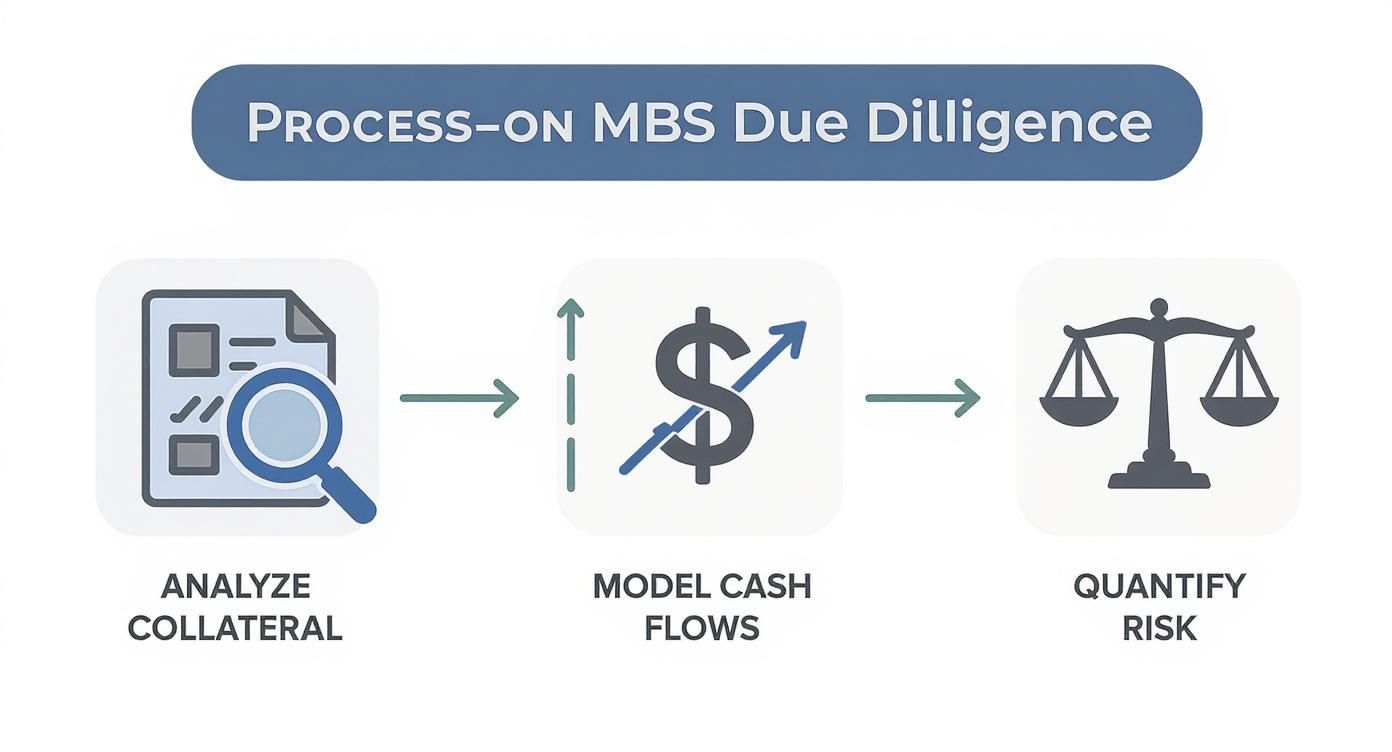
A sound purchase is always predicated on rigorous collateral analysis, cash flow modeling, and risk assessment.
Understanding Pricing and Spreads
Once a venue and security are selected, a price must be obtained. MBS pricing is typically quoted as a spread relative to a benchmark, usually a U.S. Treasury security. A price might be quoted as "110 basis points over the 10-year Treasury." This spread compensates the investor for the risks specific to MBS, primarily prepayment risk.
The difference between the dealer's buying price (bid) and selling price (ask) is the bid-ask spread, which represents the transaction cost. For a highly liquid Agency MBS, this spread can be very narrow. For a non-Agency bond that trades infrequently, the spread will be wider, reflecting lower liquidity and higher perceived risk.
Navigating the Trade Settlement Process
After a price is agreed upon, the trade proceeds to settlement. This is the back-office process where the security is transferred to the buyer's account and cash is transferred to the seller. In the U.S. MBS market, this process is highly standardized and secure.
Two key entities facilitate this process:
- Fixed Income Clearing Corporation (FICC): As a subsidiary of the DTCC, FICC acts as the central counterparty for the majority of Agency MBS trades. By stepping into the middle of each transaction, it significantly reduces counterparty risk and ensures a smooth settlement process.
- Custodian Banks: These institutions hold securities on behalf of investors. Upon purchase, a custodian takes delivery of the MBS, ensuring it is properly recorded and held in the client's account.
The settlement cycle for MBS is typically T+2 or T+3, meaning the transaction is finalized two or three business days after the trade date. The entire process relies on clear communication and standardized documentation to ensure the secure transfer of assets.
Post-Purchase Portfolio Monitoring
Executing the trade marks the beginning of the portfolio management phase. Active management involves continuously tracking performance, validating initial assumptions, and making decisions based on new data in a dynamic market. This ensures the investment thesis is performing as expected.
The process is centered on tracking monthly cash flows. Each month, principal and interest payments are received. These figures must be reconciled with projections, and the servicer's remittance data must be analyzed. This data provides the basis for all subsequent monitoring.
Validating Prepayment Assumptions
A critical aspect of post-trade analysis is comparing actual prepayment speeds to the figures used in the pre-trade model. Each month, the realized Conditional Prepayment Rate (CPR) is calculated and compared to the forecast. This exercise confirms whether the bond is performing in line with expectations.
Deviations can signal a risk or an opportunity. If prepayments are consistently slower than projected during a stable rate environment, the yield-to-maturity may exceed initial models. Conversely, a sudden increase in prepayments could indicate an unanticipated refinancing wave that will shorten the bond's average life and reduce its total return.
At its core, post-trade analysis addresses a single question: did this security perform as projected? Answering this question on an ongoing basis is fundamental to disciplined position management.
Scaling Monitoring Systems
Manual tracking becomes impractical when managing a portfolio of multiple securities. Portfolio management systems and APIs are essential for this reason. Automated data feeds can import monthly remittance reports for all holdings, streamlining the monitoring process.
Automation enables several key functions:
- Real-time Analytics: Generate current reports on yield, total return, and duration for individual securities or the entire portfolio.
- Deviation Alerts: Configure alerts to be notified when a security's CPR or delinquency rate moves outside of a predefined range.
- Constant Re-evaluation: Automatically incorporate new market data—such as changes in Treasury yields or housing price indices—into models to maintain the accuracy of forward-looking projections.
APIs from platforms like Dealcharts are particularly useful for this purpose. They allow structured finance data to be integrated directly into proprietary analytics tools, creating a seamless and efficient monitoring workflow.
Making Hold/Sell Decisions
Monitoring provides the information needed to make active decisions regarding when to hold, increase, or sell a position. The decision to sell an MBS should be as disciplined as the initial purchase process.
Key triggers for a potential sale include:
- Thesis Invalidation: The security is not performing as expected. Prepayment speeds may be significantly different than modeled, or credit performance may be deteriorating.
- Market Shifts: A significant change in interest rates, credit spreads, or the housing market has altered the security's risk/reward profile.
- Relative Value: Another security is identified that offers a more attractive yield or a better risk profile, making a portfolio rotation advantageous.
The mortgage-backed securities market is large and constantly evolving. In the U.S., commercial and multifamily mortgage debt outstanding is $4.81 trillion. This market continues to grow; multifamily debt increased by $19.9 billion in a single quarter to $2.16 trillion. This constant issuance creates a deep pool of opportunities, making active management and the search for relative value essential. These trends can be further explored on the MBA's site on commercial and multifamily debt.
Frequently Asked Questions About Buying MBS
Even with a structured approach, several common questions arise when first investing in mortgage-backed securities.
What is the difference between a TBA and a Specified Pool?
The To-Be-Announced (TBA) market is the highly liquid trading mechanism for Agency MBS. When trading a TBA, a participant agrees to buy a generic mortgage bond with a known issuer, coupon, and maturity, but the specific underlying mortgage pool is not known until shortly before settlement. The system is designed for standardization and high-volume trading.
A specified pool, in contrast, is a unique, identified pool of mortgages. An investor can analyze its specific collateral characteristics before executing a trade. Investors often pay a price premium, or a "pay-up," for specified pools that have desirable features, such as low loan balances or specific geographic diversification, which may offer enhanced prepayment protection.
How do interest rate changes affect MBS prices?
The relationship is more complex than a simple inverse correlation. Prepayment risk introduces a feature known as negative convexity.
When interest rates rise, MBS prices generally fall, similar to other fixed-income securities. However, the price decline may be exacerbated because rising rates discourage refinancing, extending the bond's duration at a time when its yield is below current market rates.
When interest rates fall, the effect can also be adverse. A drop in rates typically triggers a wave of refinancing. These prepayments return principal to the investor sooner than expected, forcing reinvestment at the new, lower rates. This can significantly reduce the investment's total return.
For an MBS investor, a sharp drop in interest rates is not necessarily beneficial. The resulting increase in prepayments can erode the total return that was projected at the time of purchase.
Are credit ratings relevant for MBS?
Credit ratings are critical, but primarily for non-agency MBS. Because these securities lack a government guarantee, rating agencies like Moody's and S&P perform an essential function. They analyze the collateral and transaction structure to assign a rating to each tranche, from AAA down to non-investment grade.
For many institutional investors, these ratings are determinative, as their investment mandates often restrict them to investment-grade securities.
For agency MBS, credit ratings are largely a non-issue. The principal and interest payments are guaranteed by the GSEs or Ginnie Mae, which effectively eliminates credit risk.
Article created using Outrank